
Stress is an unavoidable part of life. Between demanding careers, financial responsibilities, family obligations, and personal challenges, many people struggle to find healthy ways to manage emotional pressure.
For some, having a drink after work or using a substance to relax becomes a way to temporarily escape stress, anxiety, sadness, or overwhelming thoughts.
But when does occasional substance use become a problem? And how can you recognize when coping with stress has developed into substance dependence or addiction?
The answer is not always obvious.
Using alcohol or drugs to manage stress can gradually create a cycle of emotional dependence, increased substance use, and worsening mental health. Recognizing the warning signs early can help prevent more serious consequences.
At Mar Y Sol Mental Health Experts, located in Danbury, Connecticut, we provide comprehensive outpatient psychiatric care, psychotherapy, and substance use disorder treatment to help individuals understand their symptoms, develop healthier coping strategies, and work toward lasting recovery.
Why Do People Use Alcohol or Drugs to Cope With Stress?
Stress affects everyone differently. Some people exercise, seek social support, or practice relaxation techniques. Others turn to alcohol, cannabis, prescription medications, or other substances to temporarily escape uncomfortable emotions.
Common stressors that may contribute to substance use include:
Work-related stress and burnout
Financial difficulties
Relationship conflicts or loneliness
Family and caregiving responsibilities
Anxiety, depression, or unresolved trauma
Chronic pain or sleep disturbances
Major life transitions or personal losses
Alcohol and certain drugs can temporarily reduce tension or emotional discomfort. However, this relief is often short-lived.
As the effects wear off, the original stressors remain. In some cases, substance use can increase anxiety, disrupt sleep, worsen depression, and impair emotional regulation.
Over time, a person may begin relying on substances rather than developing healthier ways to manage difficult emotions.
This pattern is commonly referred to as self-medication.
How Does Stress Affect the Brain and Increase the Risk of Addiction?
Understanding the relationship between stress and addiction begins with understanding how the brain responds to emotional pressure.
When a person experiences stress, the brain activates systems involved in detecting threats and responding to challenges, including the hypothalamic-pituitary-adrenal (HPA) axis.
This response leads to the release of stress hormones, including cortisol.
Although the stress response is essential for survival, chronic activation can contribute to anxiety, sleep disturbances, difficulty concentrating, and emotional exhaustion.
Alcohol and other addictive substances influence the brain's reward, motivation, and stress-regulation systems.
For example, many addictive substances increase dopamine signaling in reward-related pathways, reinforcing behaviors associated with substance use.
When someone repeatedly experiences temporary emotional relief after drinking or using drugs, the brain may begin associating substance use with stress reduction.
This can create a repeating cycle:
Stress → Substance Use → Temporary Relief → Return of Stress → Increased Urge to Use
With repeated exposure, neuroadaptations may contribute to cravings, tolerance, withdrawal symptoms, and difficulty controlling substance use.
Importantly, addiction is not simply a lack of willpower. Substance use disorders are complex medical conditions influenced by biological, psychological, environmental, and social factors.
What Are the Warning Signs That Substance Use Has Become a Problem?
One of the most common questions people ask is, "How do I know if my drinking or drug use has crossed the line?"
There is no single amount or frequency of substance use that defines addiction for everyone.
Instead, clinicians evaluate patterns of use, impaired control, cravings, and the consequences of continued substance use.
Warning signs of a possible substance use disorder include:
Drinking or using drugs more frequently or in larger amounts than intended
Needing increasing amounts to experience the same effects
Experiencing cravings or persistent urges to use
Using substances primarily to manage anxiety, stress, or emotional pain
Hiding or minimizing substance use from family or friends
Attempting to cut back without success
Neglecting responsibilities at work, school, or home
Continuing to use despite relationship or health problems
Spending significant time obtaining, using, or recovering from substances
Experiencing withdrawal symptoms when substance use decreases
You do not need to experience every symptom to have a substance use disorder.
Even a few concerning changes may indicate that professional evaluation would be beneficial.
What Is the Difference Between a Habit, Substance Dependence, and Addiction?
Although these terms are sometimes used interchangeably, they describe different experiences.
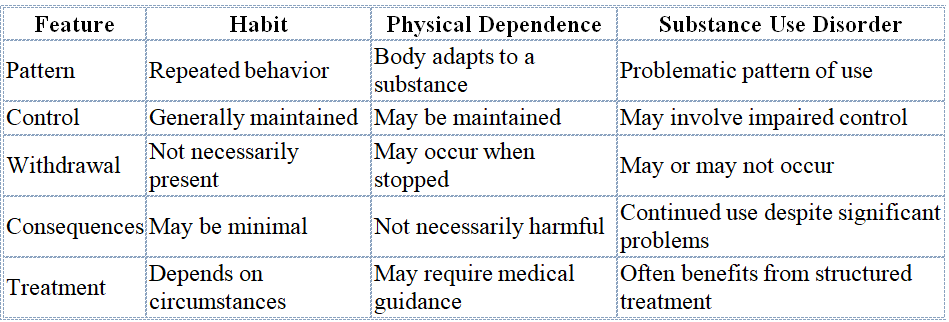
Physical dependence does not automatically mean someone has an addiction. For example, patients taking certain prescribed medications appropriately may develop physical dependence without compulsive or harmful substance use.
A substance use disorder involves a clinically significant pattern of problematic substance use, assessed using established diagnostic criteria.
The important question is not simply how often someone uses a substance, but whether substance use is affecting their health, relationships, responsibilities, or ability to make choices.
Can Alcohol or Drug Use Make Anxiety and Depression Worse?
Yes. Although alcohol and certain substances may initially produce relaxation or emotional relief, repeated use can worsen underlying psychiatric symptoms.
Alcohol, for example, is a central nervous system depressant that can disrupt sleep architecture, impair emotional regulation, and contribute to depressive symptoms.
Other substances may increase anxiety, irritability, mood instability, or difficulty concentrating.
People experiencing depression, anxiety disorders, post-traumatic stress disorder (PTSD), or other mental health conditions may be particularly vulnerable to using substances as a form of self-medication.
This relationship can also work in both directions.
Mental health symptoms may contribute to substance use, while substance use can worsen or trigger psychiatric symptoms.
When both conditions occur together, they are commonly referred to as co-occurring disorders or a dual diagnosis.
Treating both conditions together is often essential for achieving sustained improvement.
What Happens When You Stop Drinking or Using Drugs?
Some individuals experience withdrawal symptoms when they reduce or discontinue a substance after repeated use.
Depending on the substance, withdrawal symptoms may include:
Anxiety or irritability
Tremors or shaking
Sweating
Nausea or gastrointestinal discomfort
Difficulty sleeping
Restlessness
Increased heart rate
Strong cravings
Withdrawal severity varies depending on the substance, amount used, duration of use, and individual medical factors.
Important: Abruptly stopping heavy alcohol use or certain sedative medications, particularly benzodiazepines, can cause dangerous withdrawal complications, including seizures and delirium.
Individuals who may be physically dependent on alcohol or sedatives should seek medical guidance before attempting to stop.
A professional assessment can help determine whether outpatient treatment, medically supervised withdrawal management, or a higher level of care is appropriate.
Are You Using Substances to Manage Your Emotions? Try This Self-Reflection Exercise
Recognizing patterns is an important first step toward change.
For one week, consider keeping a private journal documenting your emotional state and circumstances surrounding substance use.
Ask yourself:
What was I feeling before using the substance? Was I anxious, lonely, frustrated, overwhelmed, or emotionally exhausted?
What was I hoping the substance would help me escape or manage? Was I looking for relaxation, sleep, confidence, or temporary emotional relief?
How did I feel afterward? Did I experience relief, guilt, irritability, sadness, or worsening anxiety?
Has my substance use increased over time? Am I using more frequently or needing larger amounts?
What healthier coping strategy could I try in that situation?
The purpose is not to judge yourself but to understand the relationship between your emotions, behaviors, and substance use.
If you notice repeated patterns of using alcohol or drugs to avoid uncomfortable feelings, consider discussing these observations with a mental health professional.
What Are Healthier Ways to Cope With Stress Without Alcohol or Drugs?
Developing alternative coping strategies can reduce reliance on substances and improve emotional resilience.
Some evidence-informed strategies include:
Regular physical activity: Walking, swimming, cycling, or other enjoyable movement can help reduce stress and support emotional well-being.
Mindfulness and relaxation: Deep breathing, meditation, and grounding exercises may help manage anxiety and physiological tension.
Healthy sleep habits: Maintaining consistent sleep and wake times supports mood regulation and cognitive functioning.
Social connection: Talking with trusted friends, family members, or support groups can reduce isolation and provide emotional support.
Psychotherapy: Cognitive behavioral therapy (CBT) and other evidence-based approaches can help individuals identify triggers, challenge unhelpful thought patterns, and develop healthier responses to stress.
Professional psychiatric evaluation: When anxiety, depression, trauma, or other psychiatric conditions contribute to substance use, treating the underlying symptoms may improve recovery outcomes.
Healthy coping skills take practice. The goal is not to eliminate stress completely but to develop effective ways to respond to it.
How Can Therapy and Psychiatric Treatment Help With Substance Use Disorders?
Substance use disorders are treatable medical conditions.
Treatment should be individualized based on the person's substance use history, psychiatric symptoms, medical needs, and recovery goals.
At Mar Y Sol Mental Health Experts in Danbury, CT, we recognize that substance use and mental health are often closely connected.
Our outpatient treatment approach may include:
Comprehensive Psychiatric Evaluation
A detailed assessment helps identify substance use patterns, underlying psychiatric conditions, medical considerations, and appropriate treatment options.
Individual Psychotherapy
Therapy can help patients understand the emotional triggers associated with substance use and develop practical coping strategies.
Medication Management
When clinically indicated, psychiatric medications may be used to treat co-occurring conditions such as depression, anxiety, or other mental health disorders.
Medication-Assisted Treatment for Substance Use Disorders
For appropriate patients, medications can play an important role in reducing cravings, managing symptoms, and supporting recovery.
Treatment options may include buprenorphine-based medications, such as Suboxone or Sublocade, for opioid use disorder, and medications such as naltrexone or Vivitrol for eligible patients with alcohol or opioid use disorders.
Medication selection depends on diagnosis, clinical history, safety considerations, and individualized evaluation.
Integrated Treatment for Co-Occurring Disorders
When substance use occurs alongside anxiety, depression, PTSD, or other psychiatric conditions, addressing both conditions in a coordinated treatment plan can support better outcomes.
Our goal is to provide compassionate, evidence-based care in a professional, respectful, and nonjudgmental environment.
Outpatient Substance Use Disorder Treatment in Danbury, Connecticut
Seeking help for alcohol or drug use does not necessarily mean entering a residential rehabilitation program.
Many individuals benefit from outpatient substance use disorder treatment, which allows them to receive professional support while continuing appropriate work, school, and family responsibilities.
At Mar Y Sol Mental Health Experts, we offer outpatient psychiatric services and individualized treatment planning for patients experiencing substance use concerns and co-occurring mental health conditions.
Our office is located at:
Mar Y Sol Mental Health Experts
46 Federal Road, Suite d
Danbury, CT
We provide in-person services in Danbury and telehealth services where clinically appropriate and permitted by applicable licensing and prescribing requirements.
Our clinical team works with patients to identify appropriate treatment options and determine whether outpatient care or a higher level of care is needed.
When Should You Seek Professional Help for Stress and Substance Use?
You do not have to wait until substance use causes a major crisis to seek help.
Consider scheduling a professional evaluation if:
You regularly use alcohol or drugs to relax or escape stress.
You have difficulty reducing or controlling your substance use.
Your anxiety or depression seems worse after drinking or using drugs.
Your family or friends have expressed concern.
You experience cravings or withdrawal symptoms.
Substance use is interfering with your health, work, or relationships.
Early intervention can help reduce complications and provide an opportunity to address both substance use and the stressors contributing to it.
Take the First Step Toward Recovery With Mar Y Sol Mental Health Experts
If alcohol or drugs have become your primary way of coping with stress, it may be time to explore healthier and more sustainable options.
You do not need to face these challenges alone.
At Mar Y Sol Mental Health Experts, we provide individualized outpatient mental health and substance use disorder treatment in Danbury, Connecticut.
Whether you are concerned about increasing alcohol consumption, prescription medication misuse, opioid use, or co-occurring anxiety and depression, our team can help you explore appropriate treatment options.
Your mental health matters, and recovery is possible.
Contact Mar Y Sol Mental Health Experts today to request an appointment or learn more about our services.
If you or someone you know is experiencing a mental health crisis, For a medical emergency, including severe withdrawal symptoms or overdose, call 911.
Frequently Asked Questions About Stress and Substance Use
Is drinking alcohol after a stressful day a sign of addiction?
Not necessarily. However, regularly relying on alcohol to manage stress, increasing consumption, or finding it difficult to relax without drinking may indicate a concerning pattern. A professional evaluation can help determine whether substance use has become problematic.
Can stress cause substance use disorders?
Stress alone does not cause addiction, but chronic stress can increase vulnerability to problematic substance use. Genetics, mental health conditions, trauma, environmental factors, and substance exposure also contribute to the risk.
How do I know if I am self-medicating with alcohol or drugs?
You may be self-medicating if you repeatedly use substances to manage anxiety, sadness, loneliness, insomnia, or other uncomfortable emotions rather than addressing the underlying causes.
Can anxiety and depression lead to substance abuse?
Yes. Some individuals use alcohol or drugs to temporarily relieve symptoms of anxiety or depression. However, substance use can also worsen psychiatric symptoms, creating a cycle that may require integrated mental health and addiction treatment.
Can substance use disorders be treated without inpatient rehabilitation?
Yes. Many patients can receive effective outpatient treatment, including psychotherapy, psychiatric care, and medications for substance use disorders when appropriate. The appropriate level of care depends on the severity of symptoms, withdrawal risk, medical stability, and individual circumstances.
Does Mar Y Sol Mental Health Experts offer medication-assisted treatment?
Yes. Mar Y Sol Mental Health Experts offers outpatient treatment options for eligible patients with substance use disorders, including medication-based treatment for opioid and alcohol use disorders when clinically appropriate.
Where can I find outpatient substance use disorder treatment near Danbury, CT?
Mar Y Sol Mental Health Experts provides outpatient psychiatric care and substance use disorder treatment at 46 Federal Road, Suite d, Danbury, Connecticut. Patients can contact the office to learn more about available services and appointment options.
This article is intended for educational purposes and does not replace individualized medical or psychiatric evaluation.
