
How Psychiatric Medication Management Works at Mar Y Sol
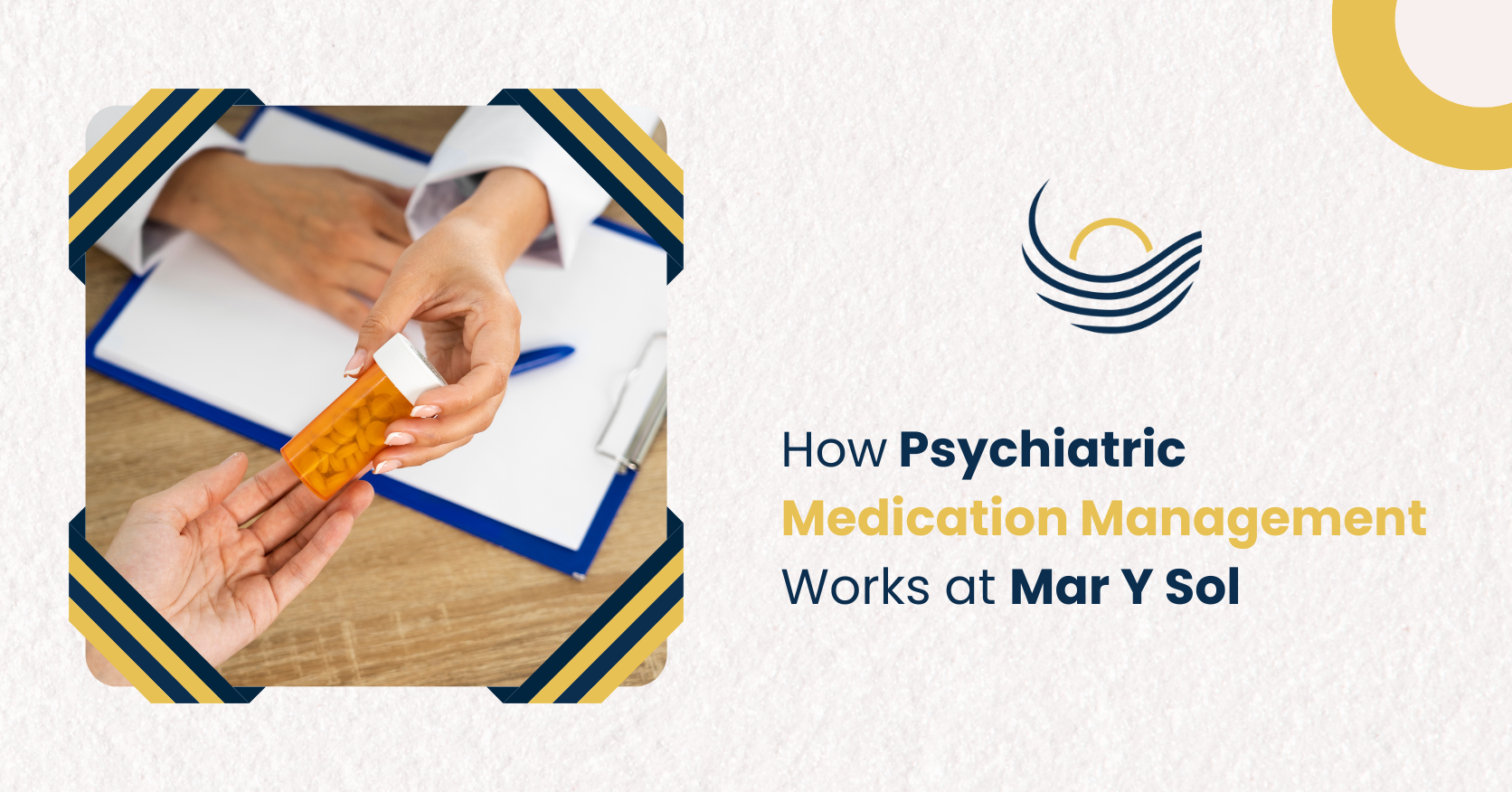
People who seek help with medication management often wonder how it works and what it entails. Some wonder if it’s even right for them.
At Mar Y Sol, Medication management is uniquely designed for each individual. It is not a rigid, mechanical process.
It is a collaborative process and reflects your unique situation.
What Medication Management Entails
Regardless of what type of medication a patient needs, there must be a collaboration with a provider.
This could be a psychiatrist, psychiatric PA or a PMHNP, and it needs to be a constructive partnership to determine what best works for the individual patient.
After the provider issues a prescription, the patient takes the medication, provides feedback. The provider may make changes to the medication (s). If needed.
This conversation doesn’t only happen once. It’s ongoing.
Some of the major mental health symptoms experienced by patients are caused by a chemical imbalance in the brain.
Neurotransmitter imbalances that include serotonin and dopamine can cause patients to experience:
Anxiety
Mood instability
Medications such as mood stabilizers and antidepressants can help with balance and can also make therapy and daily life easier.
The process is simple:
The provider prescribes an intervention based on your symptoms and history
You take the prescribed medication and note what changes (or stay the same)
You return, discuss the outcomes, and re-evaluate for further treatment.
The First Appointment
The first appointment consists largely of the provider listening to what is important for you to share and gathering information about the concerns, symptoms , its duration, and its impact on your life.
In your past treatments, they will be interested in your history, your family history of mental illness, what you take (medications, supplements, etc.), and what you’re prescribed.
They want to know about your life. They want to know how work is going, how the relationships are, and how engaged you are in the things that are important to you.
What you are experiencing is not only a collection of symptoms.
It is about identifying your current state and your desired goals.
Treatment Plan
Based on that initial discussion, your provider will develop a plan for you. Treatment options may include:
Medication
Therapy
Lifestyle changes
Other forms of support
Mar Y Sol incorporates a holistic framework.
Your plan takes into account:
Your current circumstances and their severity
The other health problems you are dealing with
The possible interactions between your other medications and their prescriptions
Your preferences and concerns
What truly matters in your daily life
Your provider will explain the reasons for prescribing a particular medication, how it works, what your expectations should be, and possible side effects.
You will be able to ask questions. The objective is to ensure that you are comfortable with the plan.
The Follow-Up Process
When you begin taking your medications, the follow-up appointments become most integral.
Your provider has to evaluate how you are feeling, if your symptoms are improving, if the side effects are within tolerable limits, etc.
Sometimes, the first medication is effective. Other times, it may not accomplish the desired goal. This part requires some patience.
In follow-ups, your provider:
Notes changes in symptoms
Assesses side effects
Manages important medication changes, including dosage adjustments
Evaluates your overall functioning
If the first approach isn’t effective, they will combine or switch medications.
Titration is the process of adjusting the dosage of your medication to therapeutic levels without causing negative side effects.
Since some medications can take a week to have a full effect, remaining patient and consistent, and being candid about your feelings, really helps the process.
Why Mar Y Sol
We value your thoughtful access to care. It is vital, especially when you are struggling, not to wait months to get some help.
When she founded Mar Y Sol, Dr. Aura Ardon envisioned a space that is warm and calming; a place where people can obtain assistance in a timely manner.
The providers view medication as a tool. When used constructively, it helps you overcome the barriers that have been keeping you stuck.
Be it depression, anxiety, ADHD or anything else, the strategy is personalized to you.
Get Started
Mar Y Sol is with you. When you feel like the time is right, you can contact us to set up a consultation and begin the process to examine your options.
It is essential to remember that you are not in this by yourself. You have a team to support you.
FAQs
How long before I start feeling a change?
Everyone responds to treatment differently. The general timeframe for patients to see medication’s effects is 4-6 weeks.
During this time, your provider will be monitoring your progress to ensure the medication is working for you.
Is this permanent?
Not necessarily. People have varying experiences with medication. Some people choose to stay on medication long-term.
Others choose to taper off medication once they feel they have improved.
What if it doesn't work?
Your provider will do something different. They will adjust the medication prescribed to you and either change it completely to see if that is more effective.